Obtain Rutherfordton's top‑rated, trusted tree service from certified arborists who adhere to ANSI A300 and Z133. You'll obtain calibrated equipment, verified insurance, and itemized estimates detailing scope, methods, permits, and debris handling. We provide risk assessments, precision pruning, strategic removals with utility coordination, wildlife-safe practices, stump grinding to 6–12 inches, and root management near utilities. Count on transparent scheduling, real-time updates, and photo-documented results. For storm emergencies, we safely triage and rig 24/7. Discover how we safeguard your trees, property, and budget next.
Essential Highlights
Why Residents Trust Rutherfordton's Tree Services
Frequently, residents in Rutherfordton select certified arborists because professional credentials, safety protocols, and outcomes are verifiable. You prioritize practitioners who follow ANSI A300 standards, maintain calibrated equipment, and carry current liability and workers' compensation insurance. You also weigh local reputation developed through consistent performance and transparent estimates. Reliable referrals from neighbors, HOAs, and property managers decrease uncertainty, while documented training in pruning biology, risk assessment, and plant health care signals competence.
You observe community involvement—tree plantings, storm-readiness workshops, and school programs—because it demonstrates sustained stewardship. Neighborhood partnerships with civic groups and public works coordinate service schedules, lower disruption, and deliver compliant debris handling. When crews offer written risk ratings, chain-of-custody for removals, and post-service site audits, you acquire measurable assurance that decisions are sound and safe.
Certified Tree Care Services That Protect Your Property
As trees are living assets and potential hazards, certified arborists implement ANSI A300 standards and ISA best practices to secure your property with verifiable methods. They commence with a structured risk assessment, recording defects, targets, and site conditions. You get clear recommendations in line with your priorities and budget.
Arborists verify tree health using soil testing to measure pH, nutrient availability, and compaction, then implement evidence-based amendments and aeration. They execute pest diagnostics—identifying insects, pathogens, and abiotic disorders—before implementing targeted treatments, including strategic pruning, biological controls, or trunk injections when warranted. Correct pruning follows specific cut geometry, load distribution, and crown objectives to decrease stress and improve clearance.
Systematic monitoring routines assess growth rates, canopy density, and treatment outcomes, delivering documented, enduring protection for your landscape assets.
Professional Tree Extraction and Risk Management
When removal becomes the most secure choice, we conduct a structured operation that oversees load paths, fall zones, and worker exposure from the opening cut to final cleanup. You obtain a documented hazard assessment that assesses lean, decay columns, root plate stability, wind exposure, and strike potential. We coordinate traffic control and utility coordination with energy, telecom, and pipeline owners to de-energize or shield lines and set exclusion zones. Climbing crews and cranes use rigging plans that detail anchor forces, cut sequencing, and descent rates to avoid shock-loading.
Prior to beginning work, we conduct wildlife relocation if cavities or nests are present, adhering to regulatory protocols. After extraction, we stabilize the site: stump grinding depth corresponding to targets, backfill compaction, erosion controls, and soil stabilization to safeguard foundations and stop runoff.
Careful Trimming for Vitality, Form, and Aesthetic Excellence
You concentrate on precision pruning to strengthen trees and minimize risk through selective canopy thinning that boosts light penetration and wind permeability. You tackle structural defect correction by removing rubbing, co-dominant, and weakly attached limbs with proper collar cuts to stop decay and failure. You plan work with seasonal timing strategies—dormant-season cuts for strength and summer reductions for growth control—matched with species and local pest/disease pressures in Rutherfordton.
Strategic Tree Canopy Pruning
Commonly disregarded yet exceptionally powerful, selective canopy thinning prunes out specific interior branches to boost a tree's health, structure, and light penetration without disturbing its natural form. You address small-diameter, competing shoots to reduce crown density while protecting dominant scaffold branches and natural symmetry. By boosting airflow, you reduce foliar moisture duration and diminish incidence of fungal pathogens such as anthracnose.
You'll also enhance undergrowth vitality and maintain wildlife corridors by preserving habitat-bearing limbs and staggered vertical structure. Employ proper pruning cuts at the branch collar to promote compartmentalization (CODIT) and stop decay. Steer clear of lion's-tailing; distribute removals uniformly throughout the crown. Work from firm footing, apply clean, sharp tools, and follow ANSI A300/Aerial Lift safety protocols. Program thinning on multiple-year cycles to decrease stress and improve light distribution.
Correction of Structural Flaws
Though every tree possesses quirks, structural defect correction targets the specific faults that heighten risk: co-dominant stems with included bark, over-extended laterals, crossing and rubbing branches, weakly attached epicormic shoots, and abrupt lion's-tailed canopies. You decrease probability of failure by establishing a dominant leader, subordinating competing stems with reduction cuts, and cutting away or shortening conflicting branches at the branch bark ridge and collar. We assess load paths, lever arms, and evidence of internal decay using sounding and resistograph data before cutting. Where pruning alone is unable to restore reliability, you install cabling bracing to redistribute forces and limit movement at weak unions. You then balance crown mass, eliminate bark traps, and preserve proper clearance. Each intervention complies with ANSI A300 and ISA BMP guidance to protect tree health and public safety.
Timing Approaches by Season
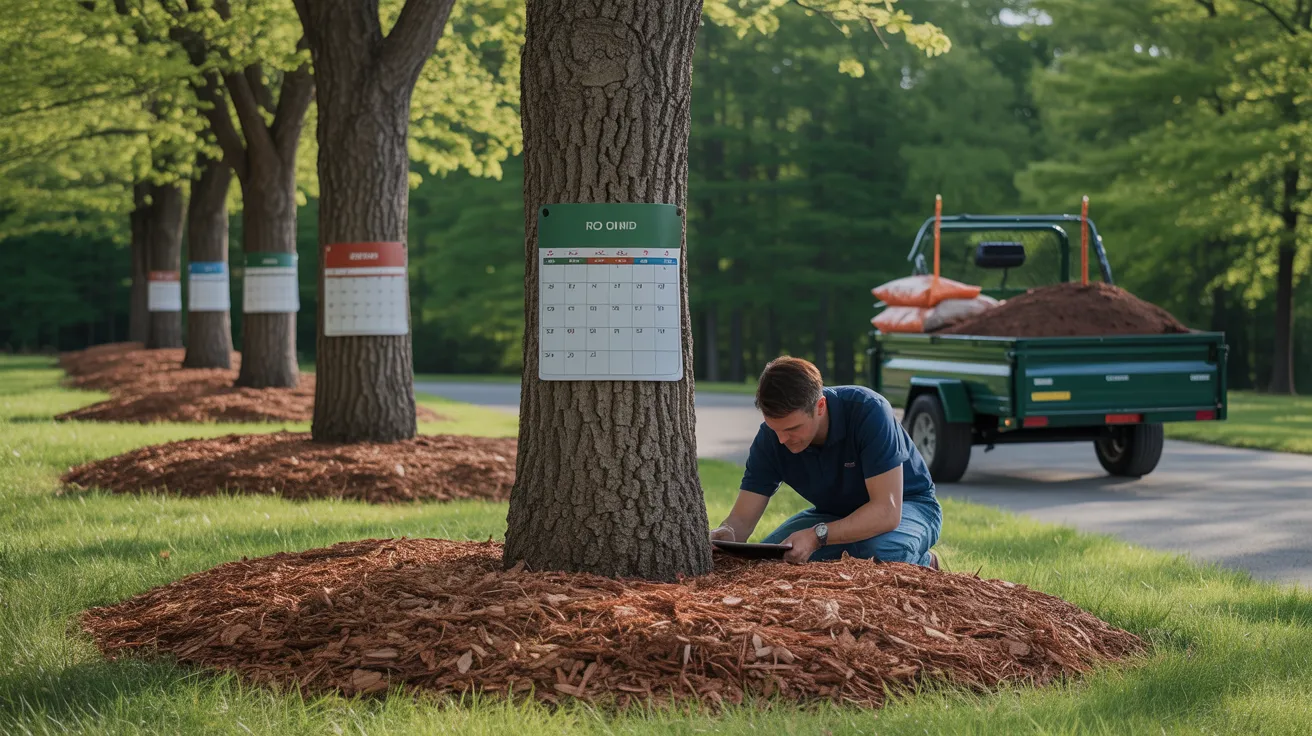
When timing cuts to a tree's biology and local climate, you optimize wound closure, minimize pest pressure, and maintain structure. You'll use a pruning calendar to plan work by species and target. In late winter, prune nearly all deciduous trees to harness dormant carbohydrate reserves and rapid spring callus formation. Prevent heavy pruning during leaf flush or drought stress to avoid canopy dieback. Time oak pruning for deep winter to minimize oak wilt vector activity. For flowering ornamentals, prune following bloom period if they set buds on old wood; prune late winter for plants that bloom on new wood.
Prioritize safety a priority: check for weak unions, secure dead limbs, and designate drop zones. Coordinate mulch placement after cutting to preserve soil moisture, buffer temperature, and shield roots without contacting the trunk flare.
Storm Damage Response and Cleanup Services You Can Depend On
When severe weather strikes Rutherfordton, you need quick emergency response with transparent ETAs and triage according to hazard severity. We dispatch ISA-certified crews to carry out safe debris removal using rigging, chainsaw PPE, and ANSI Z133 protocols to avoid secondary damage. You'll get tree stabilization, cleared access routes, and documented findings for insurance claim support.
Immediate Urgent Reaction
Severe weather can strike Rutherfordton without warning, so we act swiftly with 24/7 emergency dispatch, certified arborists, and ANSI Z133-compliant protocols to control hazardous situations and restore access. You get quick response within minutes: an incident command lead, a qualified tree risk assessor, and a lift-certified crew arrive with calibrated cutting tools, rigging gear, and traffic control. We set up a hot zone, isolate utilities, and conduct a structured scene size-up to focus on life-safety and essential infrastructure.
Our evaluation records windthrow, stem fractures, hangers, and compromised root plates. We execute engineered rigging, controlled cuts, and load management to eliminate secondary failure. Staff liaise with utility providers and first responders, copyright chain-of-command communication, read more and document each action. You receive time-stamped updates, transparent pricing, and verifiable safety checklists.
Secure Debris Extraction
With hazards stabilized and access restored, you get methodical debris removal that protects people, property, and utilities. We start with a scene assessment, identifying overhead conductors, compromised limbs, gas lines, and drainage paths. Crews section and rig fallen timber through controlled felling and mechanical advantage to stop secondary damage. We sort materials: timber for mulch or milling, brush for chipping, and leaves for compost production. Metal, roofing, and glass are directed to appropriate recycling streams.
During yard clearing operations, we use load-rated slings, ground protection mats, and reduced-impact equipment to protect soil structure and turf. We maintain chain-of-custody for debris, document before/after conditions, and confirm egress is clear. Concluding sweeps remove sharp objects and small debris, and stormwater inlets are opened to restore appropriate runoff.
Tree Stump Grinding and Root System Management
Even though a taken down tree may seem finished, the task isn't done until the stump and roots are addressed to guarantee regrowth, pests, and tripping hazards. You must have targeted stump grinding to a designated depth, typically 6–12 inches below grade, followed by root tracing to sever main lateral roots near utilities and foundations. Crews deploy calibrated grinders with sharp carbide teeth; strict equipment maintenance provides consistent cutting speed, reduced vibration, and fewer projectiles. Operators use PPE, debris guards, and underground utility locates to eliminate risk.
Once grinding is complete, we fill the area with clean fill material to encourage drainage and soil stabilization, then use a non‑residual herbicide to inhibit suckering as needed. For invasive species, we recommend staged root pruning and monitoring intervals to verify no resprout. The final grading process leaves the site replant‑ready.
Straightforward Costs, Scheduling, and Customer Support
Since decisions depend on accurate information, you get itemized, written estimates that specify scope, methods, equipment, crew size, disposal, and permit fees—no hidden line items. We offer upfront estimates based on ISA standards, ANSI Z133 safety protocols, and site-specific hazards. You'll see unit rates for pruning, removals, rigging, debris hauling, and stump grinding, so you can review alternatives.
The scheduling system we use is reliable and straightforward. We establish arrival timeframes, appoint a crew supervisor, and conduct pre-work safety reviews. Weather alternatives and utility permissions are discussed beforehand to eliminate surprises. We send you reminders, ongoing updates, and complete documentation with before/after imagery.
For customer care, a dedicated coordinator addresses concerns, manages change orders, and supports multiple payment options, including credit card, ACH, and approved financing. Satisfaction checkpoints verify quality compliance.
Questions & Answers
Are Eco-Friendly Disposal or Wood Recycling Options Available After Service?
You can request eco-friendly disposal and wood recycling. We sort clean logs for milling, chip branches for local mulching, and direct unusable material into community biomass programs. On-site chipping minimizes transport emissions and improves soil moisture retention. If you prefer, we place chips for erosion control or haul them to certified facilities. We comply with ANSI A300 and OSHA protocols, provide chain-of-custody documentation, and detail volumes, species, and destinations on your service report.
Can You Assist With Tree Selection and Planting for New Landscapes?
Absolutely—we can help with tree selection and planting for new landscapes. We start with a site selection assessment that's so meticulous it could make a botanist blush. You'll be provided with species recommendations founded on hardiness zones, soil texture, drainage, and canopy spread. We specify appropriate planting depth, mulching, and staking protocols, and install root barriers to preserve infrastructure. We focus on right-tree-right-place, drought tolerance, and disease resistance, and schedule post-planting inspections for establishment success.
What Type of Insurance Coverage Do You Maintain for Workers and Property?
You have complete insurance protection. We hold general liability to cover accidental property damage, and workers' compensation to cover employee injuries, medical expenses, and lost wages. We verify active certificates, policy limits, and endorsements (such as completed operations) prior to every season. You can request COIs naming you as both holder and additional insured. We also follow ANSI A300 and Z133 safety standards, decreasing risk and claim likelihood while ensuring clear, documented coverage for every job.
Do You Offer Written Tree Health Reports for HOAs or Permits?
Yes. You receive written assessments and arborist evaluations tailored for HOAs and permit applications. We record species, DBH, condition ratings, defects, risk categorization (following ISA TRAQ), and recommended interventions. We include photo evidence, site maps, and mitigation timelines to fulfill municipal submittal standards. If required, we'll affix a Certified Arborist license number and digital seal. You obtain PDF deliverables within 3–5 business days, with expedited turnaround provided for compliance deadlines.
Are Maintenance Plans or Seasonal Checkups Available at a Discount?
Yes—maintenance plans and seasonal checkups are available at a discount. Here's how it works: you can opt into subscription plans that bundle seasonal inspections, corrective pruning, soil nutrient management, and risk assessments at reduced rates. You receive prioritized scheduling, documented findings, and ANSI A300-compliant care. We calibrate frequency by species, age class, and site exposure to reduce storm damage and pest pressure. You save on repeat visits while maintaining safety-first, defensible tree care standards.
To Conclude
When trees start showing "senior moments" or encroach on neighboring properties, you require professionals who respond quickly and follow regulations. You'll obtain ISA‑certified inspections, ANSI A300 pruning, precision removals employing rigging techniques, and stump grinding that respects utilities and root zones. After storms, teams deploy with PPE, traffic control, and waste documentation. Proposals are broken down, timelines are verified, and risks are mitigated before work commences. Rely on Rutherfordton's qualified specialists to preserve your canopy's health—and protect your property from danger.
Comments on “ Rutherfordton Reliable Tree Pros”